
The practical answer
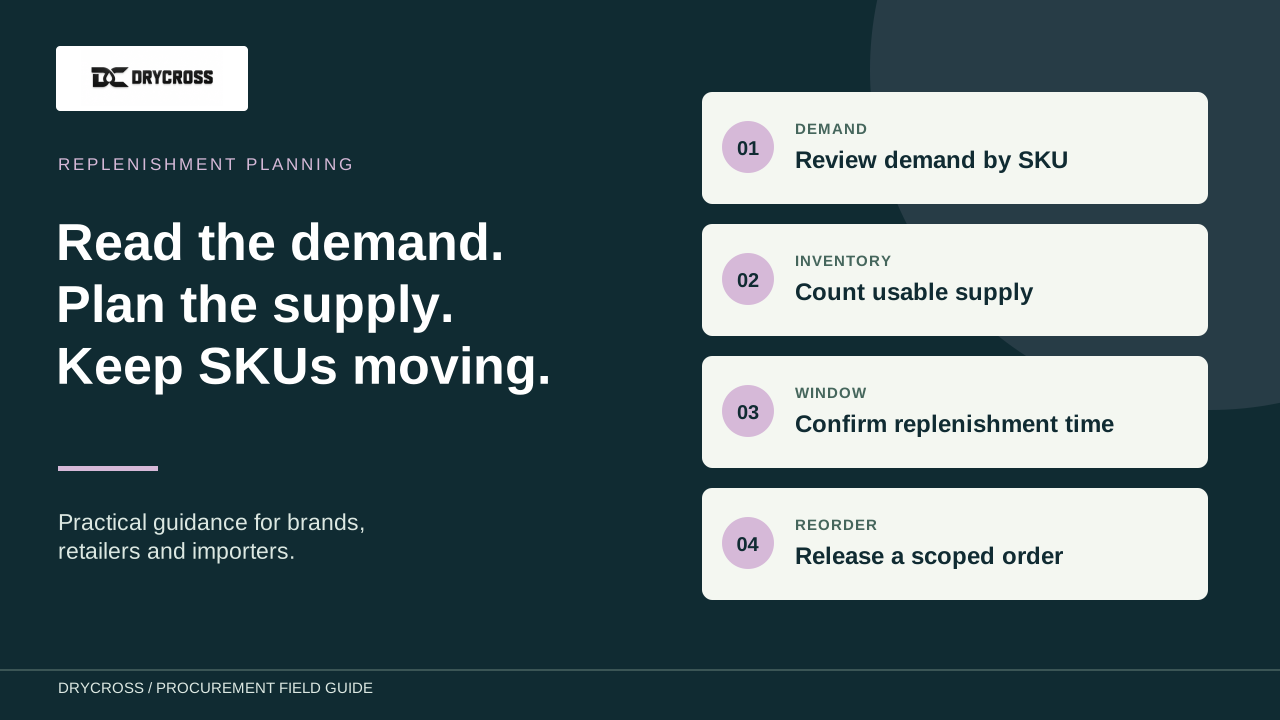
Plan dry bag replenishment from the demand and usable inventory of each SKU. Separate confirmed incoming supply from uncertain production plans, and use a replenishment window that includes approval, production, inspection, transport and receiving. Review reorder triggers against current sales and supplier information rather than repeating the quantity of the last purchase. A wholesale waterproof bag forecast is a planning document; the supplier still needs to confirm availability, quantity and delivery assumptions for each order.
Measure demand for the individual SKU
Track sales or committed customer demand by model, capacity, color and brand version. A strong overall dry bag category can hide a shortage in one size and excess inventory in another. Identify wholesale customer allocations, promotional events and seasonal peaks separately from recurring sales. Where demand history is limited, label the forecast assumptions and use a review interval that lets the team learn from the first deliveries. An importer of dry bags should distinguish units sold from units returned, cancelled or temporarily unavailable. Record how out-of-stock periods affected observed sales so a low number is not automatically interpreted as low customer interest.
Build a usable inventory position
Start with units available for sale, add confirmed incoming quantities and subtract units committed to customer orders. Exclude damaged stock, inspection holds and inventory reserved for another program unless the team has released it. Track incoming supply by expected receiving date so a late shipment does not appear to cover demand next week. For waterproof backpacks wholesale, keep accessory completeness in the inventory review: a bag awaiting its agreed strap set may not be saleable. Reconcile the warehouse record with open purchase orders regularly. The aim is a consistent planning position, not an optimistic total that counts every item somewhere in the supply chain.
Confirm the complete replenishment window
Ask the waterproof bag supplier to separate artwork or specification approval, material readiness, production, inspection and dispatch. Add the transport and warehouse receiving assumptions used by your own team. A repeat product can still require review if a component, material lot or logo revision has changed. Do not assume a reorder automatically skips all approvals. Record a confirmed milestone as confirmed and an estimate as an estimate. For a private label dry bag program, align label and packaging readiness with the product schedule. The planning window should reflect the actual route and destination, and should be updated when any significant milestone moves.
Use a transparent reorder trigger
One simple planning approach compares inventory position with expected demand during the replenishment window plus a chosen buffer. For an illustrative SKU selling 20 units a week with a six-week planning window and a 40-unit buffer, that trigger would be 160 units. These figures are an example, not a DryCross lead-time or demand commitment. The order quantity is a separate decision influenced by minimums, carton multiples, cash planning and the desired cover after receipt. Review whether demand is steady enough for this simple approach. Seasonal launches or irregular distributor orders may need a dated demand schedule instead of an average weekly rate.
Translate the forecast into a supplier discussion
Share the forecast period, SKU split and confidence level before requesting a production reservation or quotation. Distinguish a nonbinding estimate from a confirmed purchase order in your own project records. Ask which materials or components may constrain the proposed quantities and whether a consolidated or staged delivery is practical. A bulk dry bags supplier needs the variant mix rather than only a total unit figure. Keep proposed changes visible, including new colors or logo versions. When discussing repeat-order pricing, compare the same specification, packing and delivery basis so a lower headline price does not conceal a changed sourcing scope.
Review the forecast after each receiving cycle
Compare actual demand, receipt timing and usable stock with the assumptions in the previous plan. Investigate whether a shortage came from demand growth, a delayed milestone, rejected units or an inaccurate inventory record. Update the next forecast and flag slow-moving variants before ordering the same mix again. For distributors of waterproof backpacks, this review connects customer demand with the factory discussion without turning every reorder into a new development project. Keep technical revisions linked to their approved sample records, while maintaining a separate commercial replenishment schedule. Assign an owner and a next review date so the plan remains a working purchasing tool rather than an archived spreadsheet.
Use this table in supplier discussions
| Review area | Buyer input | Decision |
|---|---|---|
| Demand | Sales and commitments by SKU and period | Separate recurring and event demand |
| Inventory | Usable stock, commitments and dated incoming units | Build a reconciled inventory position |
| Supply window | Approval through receiving milestones | Use current confirmed assumptions |
| Trigger | Window demand and selected buffer | Review when to raise the reorder |
| Order quantity | MOQ, carton mix and target cover | Confirm quantity separately from timing |
Your sourcing checklist
- SKU-level demand history and forecast assumptions
- Usable stock and customer allocations reconciled
- Incoming quantity with expected receiving dates
- Current milestones and buffer rationale
- Reorder quantity, variant split and review owner
Keep the agreed scope with your model reference and quantity when requesting a quotation.
Buyer questions
Should the next dry bag order repeat the previous quantity?
Only if current demand, inventory, supply assumptions and commercial constraints support that quantity. Review the SKU mix and expected receipt period before confirming a reorder.
Is safety stock a fixed percentage for all waterproof bags?
No. Choose a buffer based on the demand and supply uncertainty of the particular SKU and review it as information improves.
Does a forecast reserve factory capacity or material?
A forecast alone should not be treated as a reservation. Clarify with the supplier what arrangement, commitment and timing would be required to reserve the proposed supply.
BUILD A CLEARER PROJECT BRIEF
Discuss the next step with DryCross
Send your model reference, quantity, destination and the requirements gathered from this guide. Our team will review the scope before confirming a quotation.
Discuss your sourcing project ↗Waterproof products · B2B sourcing · Factory capabilities · Customization