
QUICK BUYER ANSWER
The practical answer
Hot-air and RF welding are both useful, but neither is universally better. Material chemistry, coating structure, panel geometry, seam length, attachment design and order volume determine the practical process. Buyers should approve the intended material on the actual machine, define seam dimensions and appearance, validate peel or leak performance, and prevent unapproved process substitution after sampling.
Confirm material compatibility
Welding depends on thermoplastic layers that soften and bond within a workable process range. Base fabric, coating chemistry, thickness, print, surface treatment and backing can change the result. Ask the factory to identify the exact material construction and run trials before final pricing. A visual bond on a sample strip does not by itself prove long-term strength or water resistance.
Match the process to the seam geometry
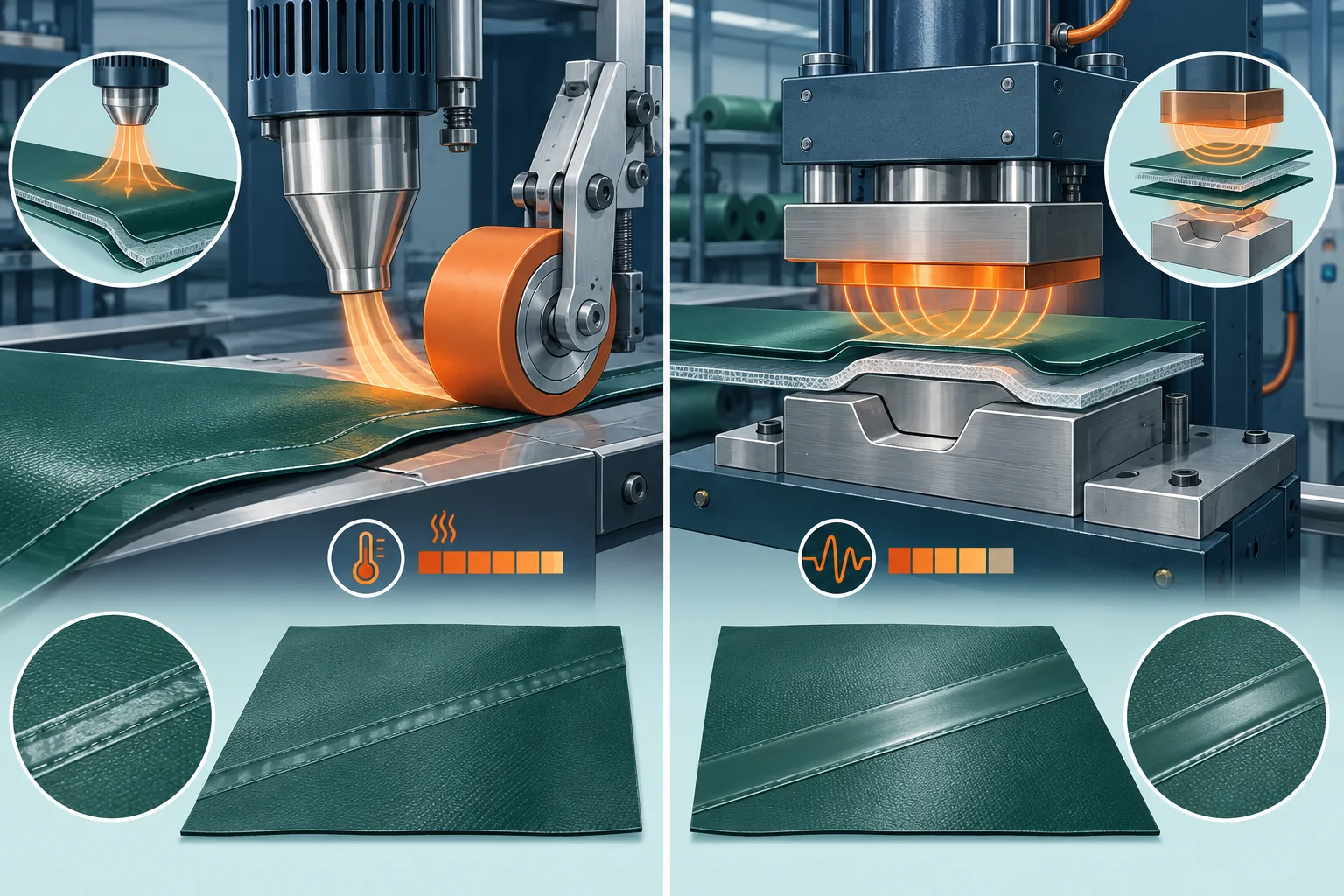
Hot-air equipment can follow long or continuous paths and may suit three-dimensional assembly with trained control. RF welding uses an electrode and can deliver repeatable pressure and energy over a defined shape, including patches and details. Access, curves, seam intersections and nearby hardware influence which process is stable. Review the actual panel layout instead of choosing from a generic capability list.
Separate tooling from running cost
RF electrodes, locating fixtures and special molds can create one-time charges but improve repeatability for suitable volume. Hot-air welding may require less dedicated tooling while depending more on setup, guide design and operator control. Ask suppliers to separate tooling, sample setup and unit conversion cost so later reorders and design changes remain understandable.
Validate strength, sealing and appearance
Set acceptance for seam width, alignment, wrinkles, scorching, edge lift, distortion and contamination. Add peel, burst or leak checks appropriate to the product. Test critical intersections and attachment patches, not only straight coupons. Keep machine settings and approved samples under controlled records so production does not drift toward a faster but weaker condition.
Control mixed-process construction
Many waterproof backpacks and duffels combine welding with sewing, taping or bonded reinforcements. Map which seams use each process and how transitions are sealed. Confirm that load-bearing straps do not transfer force into a thin film seam without reinforcement. A hybrid product can perform well when every interface is designed, documented and inspected as part of one system.
Use this table in supplier discussions
| Review area | Buyer input | Decision |
|---|---|---|
| Material | Coating chemistry and thickness | Confirms weldability |
| Geometry | Long seam, curve or shaped patch | Selects stable process |
| Commercial | Tooling and unit labor | Clarifies total cost |
| Validation | Strength, leakage and appearance | Locks production window |
Information to include in your inquiry
- Product type or reference model
- Quantity by size, color and artwork
- Intended use and required features
- Destination and required delivery date
- Sample, packing and evidence requirements
Frequently asked buyer questions
Is RF welding always more waterproof than hot-air welding?
No. Performance depends on compatible material, joint design, settings, equipment condition and process control. Validate the actual construction.
Can a supplier switch welding methods after sample approval?
Treat a process change as controlled. Review the reason, repeat critical tests and approve a revised sample before bulk use.
DRYCROSS · DONGGUAN, CHINA
Turn the checklist into a project brief
Send the reference model, quantity, destination and requirements that matter to your customer. DryCross will review the scope before confirming a quotation.
Discuss this sourcing project