
QUICK BUYER ANSWER
The practical answer
For an OEM wet and dry compartment backpack, define which compartment protects dry belongings and which stores damp equipment. Specify the partition, each opening and the route water could take between them. Two pockets do not automatically provide two sealed zones. Approve a loaded sample with the intended contents, then agree separate checks for external water exposure and moisture transfer from the wet compartment.
Draw the storage boundary before choosing the silhouette
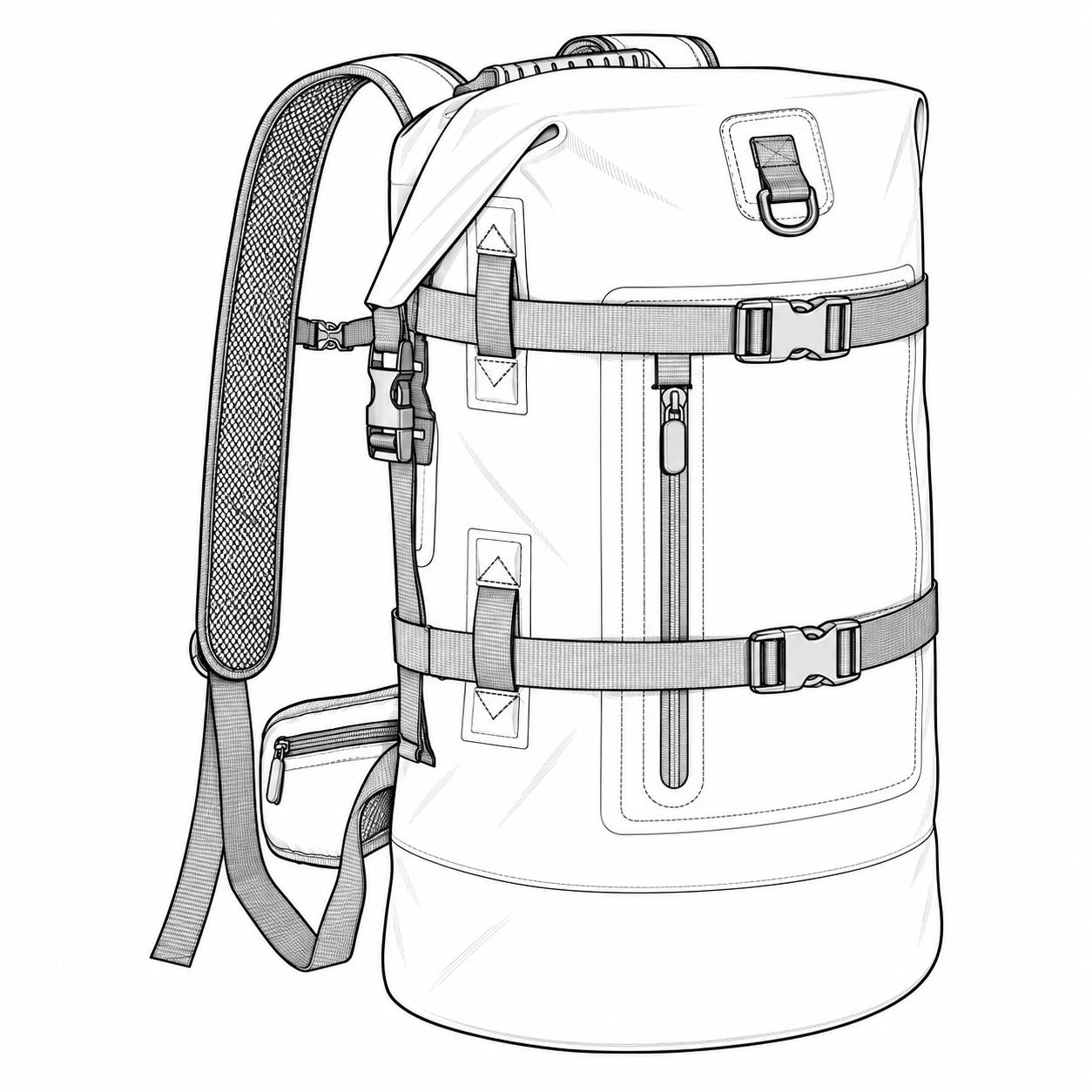
A retailer may want one backpack for swimwear, a towel and dry clothing, while a commuting brand needs a protected compartment beside items that are merely damp. These are different briefs. Mark every compartment on front, rear and interior views; identify which is sealed, ventilated or only organizational. Specify whether the wet section is an exterior pocket, removable pouch or internal divider. A drawing prevents the phrase wet and dry separation from being interpreted as a decorative second zip pocket.
Measure usable volume with both compartments occupied
Nominal total capacity says little about how the compartments share space. Load the proposed wet section with the intended footwear or towel, then check what remains in the dry compartment. Record usable opening dimensions and clearance for a correctly closed roll top. State whether capacity is measured open or after closure. For a custom waterproof backpack manufacturer, these details determine the pattern and development work more clearly than a request for a 40L bag with extra pockets.
Review the partition and every attachment
A divider can stop belongings from mixing without stopping water. Discuss the partition material, bottom corners, attachment method and transitions into the outer shell. Check whether stitching or zipper attachment crosses the protected area. Ask how the supplier will evaluate transfer between zones without confusing it with an external spray test. Include the bag orientation and loading condition in the sample review. Do not infer finished-compartment performance from a material description or a sketch of the lining.
Make cleaning and drying practical
A wet compartment should be accessible enough to remove sand, wipe surfaces and dry after use. Ask whether the lining can be turned out, detached or reached through the opening. Review corners that may trap moisture and how drain openings, if proposed, affect the intended protection boundary. Check the cleaning instructions on the selected materials and hardware. Avoid prescribing unverified chemicals or machine washing. Buyers should assess whether the proposed care routine is realistic for their customers and retail channel.
Approve a task-based sample instead of an empty photo
Run a short user sequence: load damp equipment, add the dry items, close both openings, carry the backpack and unpack it. Evaluate access, strap comfort, load balance and any observable transfer of moisture under agreed conditions. Compare the result with the approved drawing and record changes by version. For private label waterproof backpacks, also confirm the label and product listing distinguish pocket functions. Request MOQ, unit pricing and sample timing for the actual partition design rather than borrowing them from a standard model.
Use this table in supplier discussions
| Review area | Buyer input | Decision |
|---|---|---|
| Storage zones | Contents and required protection in each zone | Sealed, ventilated or organizational |
| Capacity | Representative loaded contents | Usable space after both zones are filled |
| Partition | Drawing and attachment detail | Moisture-transfer evaluation |
| Care | Expected cleaning routine | Accessible corners and approved instructions |
Information to include in your inquiry
- Compartment diagram and exposure
- Contents and dimensions for each zone
- Divider and access requirements
- Loaded sample evaluation plan
- Logo, quantity split and destination
Frequently asked buyer questions
Does a wet pocket make the whole backpack waterproof?
No. Identify the protected compartment and check the complete construction and closure. An organizational divider or exterior wet pocket is not evidence for a waterproof claim.
Can I add a wet compartment to an existing model?
Submit the reference model and a marked drawing for feasibility review. A changed partition may affect capacity, pattern, attachment method, sampling and MOQ; confirm these before requesting the production quotation.
DRYCROSS · DONGGUAN, CHINA
Turn the checklist into a project brief
Send the reference model, quantity, destination and requirements that matter to your customer. DryCross will review the scope before confirming a quotation.
Discuss this sourcing projectExplore relevant products · Factory capabilities · Customization · Contact DryCross