The practical answer
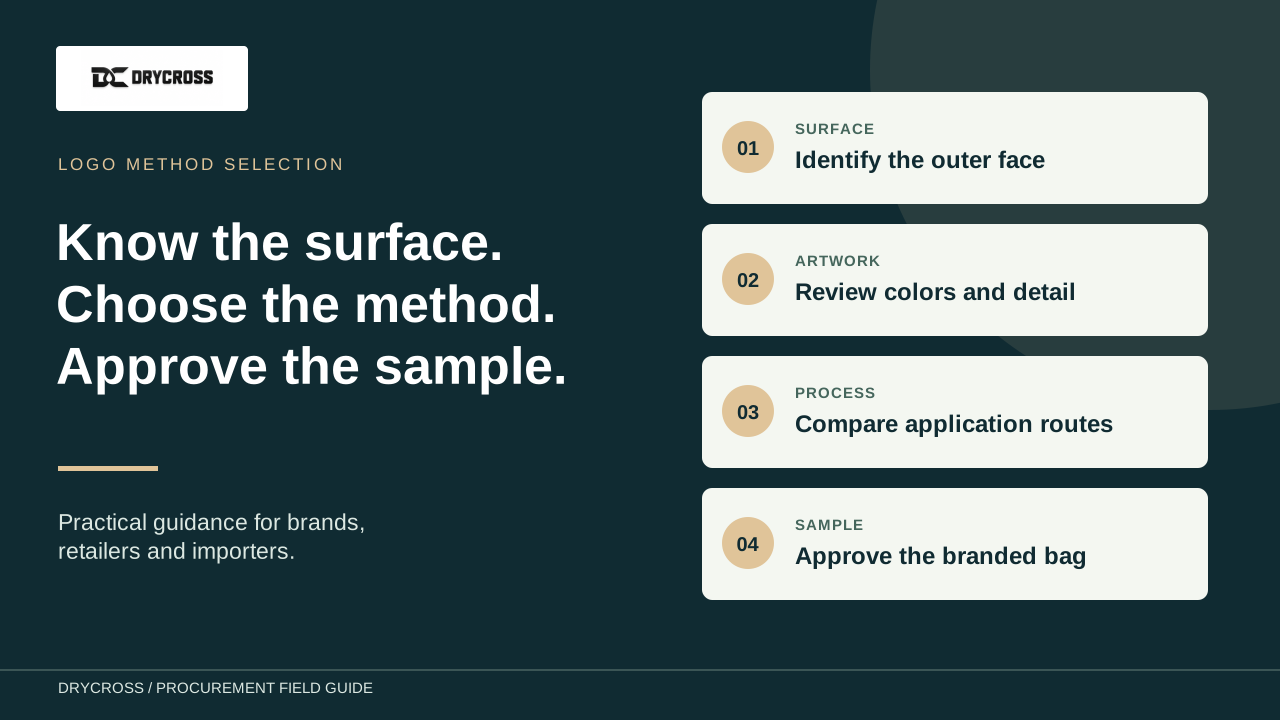
Choose a custom waterproof bag logo method using the actual outer surface, artwork and construction stage. Screen printing, transfers and patches have different preparation and application requirements; none should be approved from a material name alone. Request a representative sample on the intended surface and assess appearance, adhesion, flexibility and any effect on the waterproof construction. Quote setup and unit application costs separately before releasing a private label dry bag program.
Specify the outer face before discussing the logo
Describe what the branding process will contact: exposed film, a coated textile face, an uncoated woven panel or a separate trim. TPU or PVC in the bill of materials does not by itself identify the accessible outer surface. Include the finish, texture, color and the intended location in your brief. A waterproof backpack may combine several surfaces that need different assessments. Ask the factory to identify the proposed application area on the selected model. For custom logo dry bags, a photo and a material reference help start the discussion, but the supplier should confirm compatibility on the actual production surface before the route is approved.
Compare artwork needs with application capability
Provide the vector artwork, intended dimensions, color references and a preview showing the required orientation. Separate flat brand colors from gradients, photographs and very fine lettering so the supplier can discuss practical application options. Screen printing uses a prepared image screen; multi-color work needs controlled registration. Transfer routes use a prepared graphic that is applied to the product, with compatibility dependent on the selected system. Ask what detail can be reproduced at the final logo size and what simplification would be proposed. For promotional dry bags or corporate gift waterproof pouches, judge the physical proof against the brand brief rather than relying on a large digital rendering.
Assess heat and adhesion on the actual construction
Do not adopt a generic transfer temperature or adhesive for every coated bag. Product-specific application guidance and trials on the actual surface are needed. Siser notes that transfer materials differ in fabric compatibility and application requirements; that general guidance does not qualify an assembled waterproof bag. Ask the application partner to identify its proposed transfer system and explain the sample review. Check for coating distortion, impressions, color changes and lifting edges after the agreed conditioning. Finished backpacks with padding or pockets may need a different application arrangement from flat panels. Record the approved combination and process reference so the bulk order is tied to the reviewed sample.
Evaluate patches and labels as attachments
A welded patch needs a compatible bonding surface and an attachment layout that suits the bag. An adhesive badge requires its own adhesion review; a decorative shape does not establish service durability. A sewn label or embroidered mark introduces needle penetrations wherever it is stitched, so identify whether that area belongs to the waterproof enclosure and how the construction addresses it. A separate external trim panel may be a different route from stitching directly through the enclosure. For private label waterproof backpacks, ask to see the complete attachment rather than only the loose badge. Inspect both appearance and the surrounding construction before accepting the method.
Review process timing and quotation scope
Some branding can be applied before assembly, while a stock model may constrain access to the same location. Ask whether the proposed route requires a new panel, additional tooling, a separate patch order or a revised production sequence. Quote sample preparation, screens or molds, application positions, colors and packing separately where relevant. Do not infer a universal MOQ or a fixed application surcharge from another supplier’s catalogue. A custom waterproof dry bag manufacturer should confirm the scope for your selected model and quantity split. For repeat orders, identify which setup reference can be reused and which changes require a fresh proof before comparing unit prices.
Approve one traceable branding configuration
Review the branded product at its intended size and in its normal operating shape. Confirm dimensions, orientation, placement, color and the agreed evaluation results. Keep the artwork revision, surface reference, application method and approved sample identity together. If several product capacities share the brand, verify whether the same mark fits each panel without entering a fold or closure area. Record any accepted differences explicitly. The approval should describe a configuration the factory can repeat, not merely a preferred visual effect. For a waterproof bag OEM branding program, link the branding record to the product specification and inspect the initial production units against that combined reference.
Technical references
Check product-specific guidance with the application partner. General transfer guidance does not qualify a waterproof bag construction.
Use this table in supplier discussions
| Review area | Buyer input | Decision |
|---|---|---|
| Screen printing | Color count, detail and actual outer surface | Review a physical print and process scope |
| Transfer | Graphic system, application requirements and access | Check adhesion and surface response |
| Welded patch | Patch material, compatible surface and attachment area | Inspect the bond and surrounding construction |
| Sewn label | Attachment location and enclosure relationship | Review penetrations and complete assembly |
| Commercial scope | Setup, positions, quantity and reusable references | Quote the reviewed configuration |
Your branding checklist
- Actual outer-face material and finish identified
- Artwork revision, size and color references
- Application area and construction stage
- Representative proof and agreed evaluation scope
- Setup costs and repeat-order configuration
Keep the agreed scope with your model reference and quantity when requesting a quotation.
Buyer questions
Is heat transfer suitable for every TPU or PVC dry bag?
No. Review the exact outer surface, transfer system, application requirements and assembled construction, then approve a representative sample. A material family name is not a compatibility approval.
Can a logo patch guarantee the bag remains waterproof?
No. Review how the patch is attached and evaluate the identified complete bag against the intended protection requirements.
Which logo method is cheapest for bulk dry bags?
Compare the complete offer for the same artwork, surface, quantity and application positions. Setup, sample work and assembly access can change the total cost.
BUILD A CLEARER PROJECT BRIEF
Discuss the next step with DryCross
Send your model reference, quantity, destination and the requirements gathered from this guide. Our team will review the scope before confirming a quotation.
Discuss your sourcing project ↗Waterproof products · B2B sourcing · Factory capabilities · Customization