
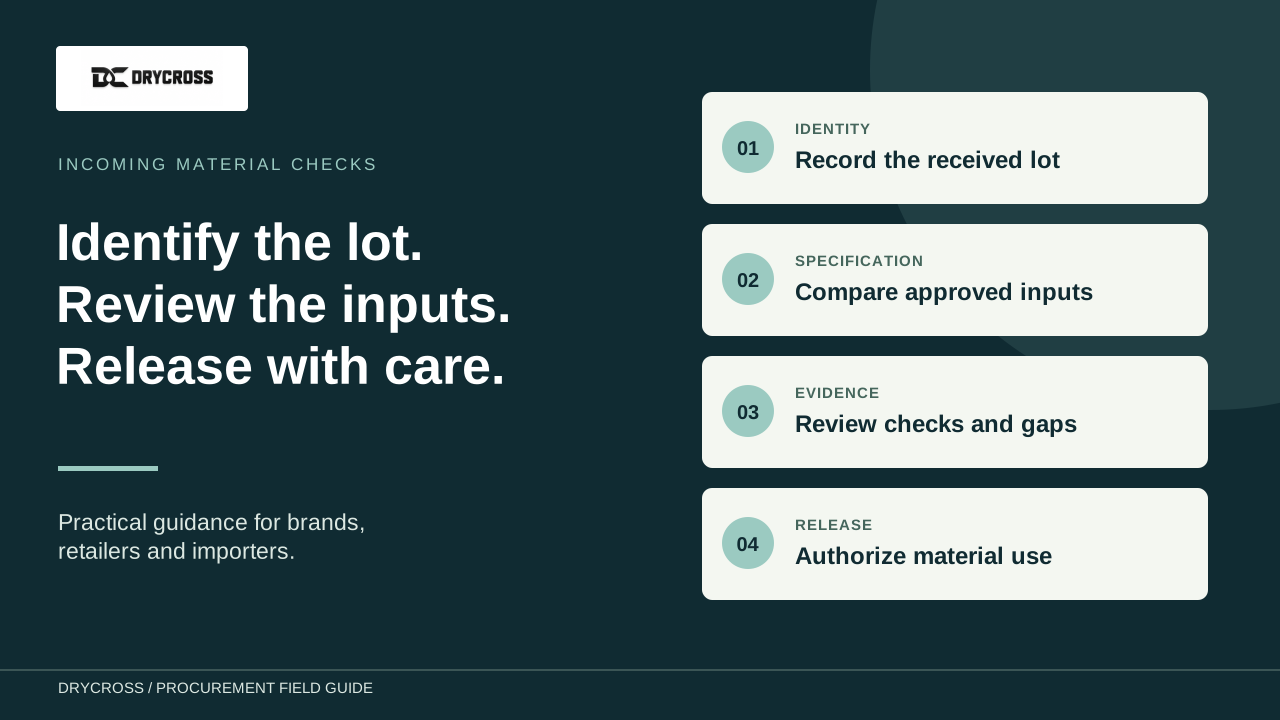
The practical answer
Inspect incoming waterproof bag materials against the approved specification before they enter cutting or assembly. Identify each received lot, define the observations and tests needed for that input, and record whether it is accepted, held or rejected. Fabric, closures and hardware need different checks. A document supplied with a material shipment should be reviewed for its scope and identity; it does not by itself approve the assembled waterproof bag or replace the agreed receiving inspection.
Create a receiving checklist from the approved brief
List the input references that matter to the selected waterproof bag: fabric construction, coating or film, finish, color, zipper system, buckle model, webbing and any specified trim. State the agreed measurement method and tolerance where dimensions or weight will be checked. A waterproof bag OEM brief that only says TPU fabric leaves important receiving decisions unresolved. Distinguish properties that can be observed on receipt from those that need a supplier document or laboratory evaluation. Use the same revision as the approved sample and purchase specification. Record any proposed alternative explicitly rather than allowing the receiving team to decide that a similar component is equivalent.
Identify lots without mixing their records
Assign a receiving reference to each identifiable delivery or material lot and retain the supplier’s original references where available. Connect the record to the material description, quantity received, delivery date and relevant purchase order. When rolls or component cartons are split, keep their identity with the remaining stock. For a wholesale dry bag program, the useful record lets the team identify which input was used in a particular production batch. Do not merge lots just because they share a catalogue color. If the supplier cannot establish a lot reference, document the limitation and agree a practical identification approach before that input is released.
Review fabric and coated surfaces using defined methods
Check the received surface against the approved reference for visible damage, contamination, unexpected texture and obvious shade differences under agreed observation conditions. Where the brief requires width, mass or thickness measurements, record the instrument, method and locations used. Sample selection should reflect the agreed receiving plan, not just the cleanest accessible piece. Additional coating, bond or water-resistance evaluations need their own defined procedure and acceptance scope. A fabric inspection is one part of waterproof bag material quality control; it does not establish finished-bag protection. Hold unclear results for technical review instead of inventing a universal pass number from another product or supplier.
Check closures and hardware as matched components
Compare zipper lengths, attachment references, buckle halves and webbing widths with the approved component schedule. Confirm that mating components operate together in the intended configuration. A buckle that closes on the bench may behave differently when paired with the specified strap, so include the agreed assembly reference in the review. For custom waterproof backpacks, note missing parts, incorrect finishes and visible damage before these inputs reach the line. Where functional or load checks are required, use the agreed method and acceptance criteria for the component or assembly. Appearance alone should not be treated as evidence of load capacity, corrosion resistance or long-term closure performance.
Separate document review from material acceptance
Review the input identity, date, method and stated scope of any supplied report or declaration. Ask whether it concerns the received material, another reference material or a component family. Mark unresolved connections rather than filing every document as approval. An importer sourcing waterproof bags in China may request specific evidence in the brief, but the receiving team still needs to confirm what physically arrived. If a property requires external verification, identify the responsible reviewer and the hold decision while that evidence is pending. Keep material acceptance distinct from product claims and market documentation, since those reviews can concern different scopes and different product identities.
Release, hold or reject with a traceable decision
Label the receiving outcome so the cutting and assembly teams know which material may be used. Record the decision owner, date, quantity and any agreed restriction. Held inputs should remain identifiable and separate from accepted stock until the issue is resolved. If an alternative is approved, update the specification and sample requirements before production proceeds. For an OEM waterproof bag factory discussion, ask how released input references are connected to production records. That connection makes later troubleshooting more specific. Receiving inspection reduces uncertainty about inputs; it still needs to work with first-piece checks, in-process controls and finished-product evaluation in the overall quality plan.
Use this table in supplier discussions
| Review area | Buyer input | Decision |
|---|---|---|
| Identity | Supplier lot, receiving reference and quantity | Maintain a link to production |
| Fabric | Construction, finish and defined measurements | Compare with approved material |
| Closures | Reference, size and matched operation | Review the intended configuration |
| Hardware | Buckle, webbing and trim compatibility | Separate appearance from performance |
| Release | Acceptance, hold or rejection with an owner | Prevent unapproved input use |
Your quality checklist
- Current material and component specification
- Received lot identity and quantity
- Defined methods and acceptance references
- Document scope and unresolved evidence
- Release status linked to production records
Keep the agreed scope with your model reference and quantity when requesting a quotation.
Buyer questions
Does a material test report approve the finished waterproof bag?
No. Review what the report identifies and evaluates. The assembled bag has its own closure, seam and attachment construction that needs the agreed product evaluation.
Can two fabric lots be combined if their colors look the same?
Only after the agreed review supports that decision. Preserve lot identity and record any approved combination instead of relying solely on visual similarity.
Should every component use the same incoming test?
No. Fabric, closures and hardware have different requirements. Define checks and acceptance references appropriate to each input and its intended assembly.
BUILD A CLEARER PROJECT BRIEF
Discuss the next step with DryCross
Send your model reference, quantity, destination and the requirements gathered from this guide. Our team will review the scope before confirming a quotation.
Discuss your quality requirements ↗Waterproof products · B2B sourcing · Factory capabilities · Customization