QUICK BUYER ANSWER
Waterproof Dry Bag Bottom Design: the practical answer
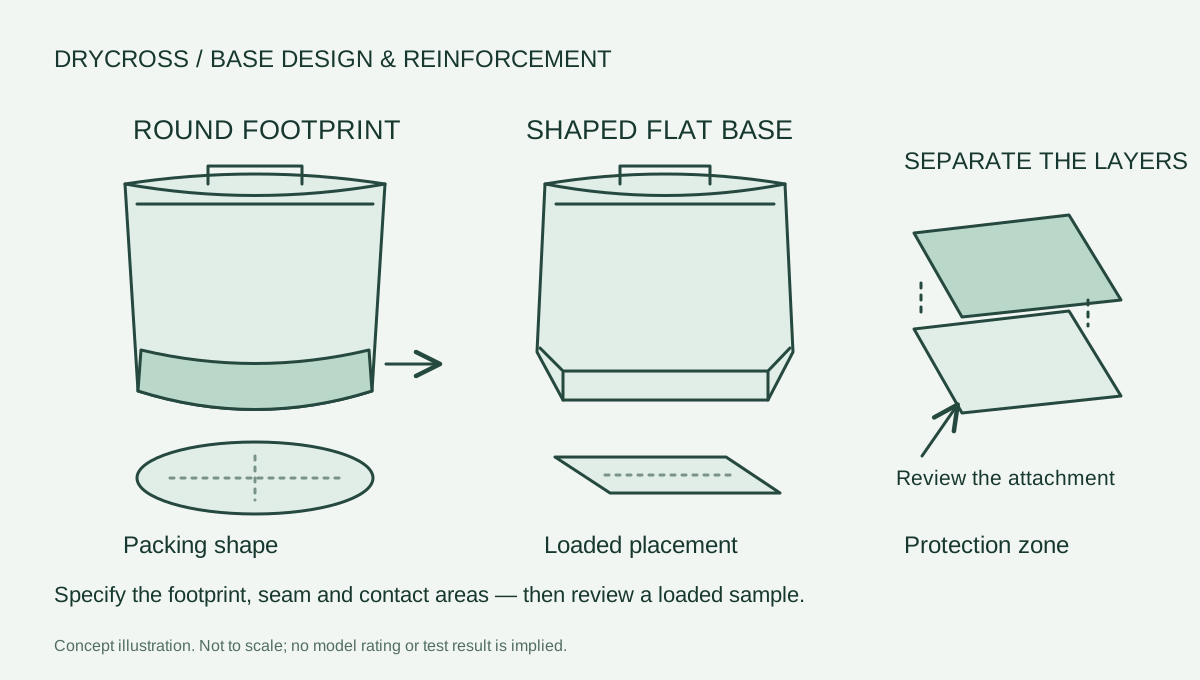
Choose a waterproof dry bag base by the intended contents, how the bag will be placed or mounted, and where it will contact other surfaces. Round and shaped flat bases create different packing footprints; reinforcement is a separate construction decision. Ask the manufacturer to define the closed dimensions, base seam and any added protection, then review a loaded sample. A reinforced bottom does not by itself establish abrasion performance, load capacity or waterproof protection for the complete bag.
Start with the kit and the contact surface
List the contents the buyer expects to pack and describe whether they are soft, rigid, irregular or likely to press against the bottom. Identify the surfaces on which the bag will be placed, carried or secured. A kayaking dry bag, retail waterproof backpack and motorcycle waterproof duffel may share a material family while having different base requirements. For custom dry bag manufacturing, include a representative kit or a dimensioned packing brief rather than only a nominal liter capacity. Map expected contact points, including straps or racks where relevant. This gives the factory a clear problem to review before suggesting a round base, a shaped base or an added protective layer.
Compare round and shaped flat bases by packing geometry
A round base gives a circular footprint; a shaped flat base can create a different width and depth for packing rectangular items or arranging bags side by side. Neither shape is automatically the better option for every outdoor product. Ask for the usable closed dimensions and review how the chosen kit sits inside the bag. A flat-looking empty panel does not guarantee a loaded bag will stand upright without support. For waterproof bags wholesale, compare the actual packing trial and intended display condition rather than assuming that a familiar silhouette proves stability. Record whether the bag must stand, lie down, fold for storage or fit a particular compartment.
Separate reinforcement from the waterproof enclosure
Ask whether the proposed reinforcement is an additional outer layer, a stronger base panel, an internal support or another specific construction. Identify what remains responsible for enclosing the contents and how the reinforcement is attached. A stronger-looking patch does not prove that the entire bag has a stronger seam or a particular water-ingress rating. ORTLIEB’s PD350 product sheet describes a reinforced base on that specific product, illustrating that base construction can be specified separately from the body. That example does not establish a DryCross material specification or performance result. For OEM waterproof backpacks, define the proposed protection zone on the drawing and confirm its relationship to the enclosure before approving development.
Background: ORTLIEB PD350 product information. This is a model-specific construction example, not a DryCross performance claim or a recommended material for every bag.
Review the base seam and reinforcement edges
Ask the waterproof bag manufacturer to show where the body meets the base and how any added layer finishes near that joint. Review the seam path, corners, attachment points and areas that become difficult to inspect after assembly. If reinforcement is bonded, welded or stitched, identify the actual method and what the sample must demonstrate. Do not set a universal seam width or choose a process solely from the material name. For a reinforced dry bag OEM brief, record the construction reference and agreed evaluations. Pay attention to edges that might catch during handling or create unwanted bulk, and inspect the surrounding surface as well as the central reinforced area.
Trial the base with representative contents
Load the sample with the agreed kit and use the intended closure procedure. Observe whether the contents concentrate contact at a corner, distort the bottom, reduce usable space or prevent the desired placement. Check access and carrying behavior alongside the base shape, because a stable footprint can still be inconvenient for the user’s task. If abrasion or other performance evaluation is required, agree the method, specimen identity and acceptance reference with the appropriate technical partner. Avoid improvising a generic wear test and advertising its result as a rating. An importer of dry bags should retain photographs and observations tied to the sample revision so the bulk specification reflects the reviewed configuration.
Compare cost, mass and packing consequences
Ask for the effect of a changed base on material use, assembly operations, sample work, unit mass and folded packing size. Reinforcement can change several of these factors, and the resulting trade-off should be compared using the same quantity and variant scope. For a bulk dry bags supplier quotation, list the base option clearly instead of treating an extra layer as an unspecified premium feature. A shaped base may also change carton planning or presentation when the product is packed flat. Confirm which dimensions and packing assumptions the supplier used. Discuss setup or development charges separately where relevant, without assuming another supplier’s price or MOQ applies to this design.
Lock the reviewed configuration before the bulk order
Keep the base drawing, material references, seam layout, reinforcement zone and loaded sample observations together. Identify any open evaluation or accepted difference before approving production. Where capacities have different bottom dimensions, check that each variant retains the intended packing and contact behavior. For a private label waterproof bag range, link the agreed construction to the model code, approved sample and inspection checklist. If a supplier proposes an alternative reinforcement later, review its effect on the same requirements rather than accepting it on appearance alone. This keeps the base decision connected to the complete outdoor bag and provides a clearer reference for factory production and repeat orders.
Specification discussion table
| Design decision | Buyer input | Sample review |
|---|---|---|
| Round base | Circular footprint and intended kit | Check usable space and placement |
| Shaped flat base | Width, depth and rectangular contents | Check loaded shape and stability |
| Reinforcement zone | Expected contact areas and proposed layer | Review attachment and surrounding construction |
| Base seam | Layout, junctions and required evaluation | Identify the finished sample and scope |
| Commercial scope | Mass, packing dimensions and quantity split | Compare the same quoted configuration |
Before you request a quotation
- Intended contents and contact surfaces
- Closed dimensions and base footprint by capacity
- Base material, seam layout and reinforcement zone
- Loaded sample observations and evaluation requirements
- Quotation, packing assumptions and approved revision
Frequently asked buyer questions
Is a flat-bottom dry bag always more stable than a round-bottom bag?
No. Review the actual loaded shape, contents and surface. A flat-looking panel alone does not establish that the bag will stand as required.
Does a reinforced bottom make the bag submersible?
No. Reinforcement and water-ingress protection are separate requirements. Evaluate the complete enclosure, closure and attachments against the agreed product scope.
Should every capacity use the same reinforcement layout?
Review the dimensions and contact behavior of each variant. Keep a separate reference where a shared layout does not cover the intended contact zone.
What should a buyer send for a reinforced dry bag quotation?
Send the model or drawing, intended contents, base dimensions, protection zone, material references, quantity split and sample evaluation requirements. Ask the supplier to state proposed alternatives clearly.
DRYCROSS / DONGGUAN HAIHE TECHNOLOGY CO., LTD.
Turn these requirements into a sourcing brief
Send the selected model or reference, quantity, destination and requirements from this guide. Our Dongguan team will review sample options, specifications and order-specific commercial terms.
Discuss your waterproof bag project ↗Browse waterproof products · Custom design options · See our factory · Contact DryCross · Explore sourcing routes